Why Ganesha is worshipped first: the head, the tusk and the mouse
Ganesha comes before every other god in every puja. The stories behind his elephant head, his broken tusk, his mouse and his love of modak.

Whatever festival or ceremony you are at, one thing never changes. The first prayer goes to Ganesha. A wedding, a housewarming, a child starting school, even a new notebook. His is the first name.
Why first?
Ganesha is Vighnaharta, the remover of obstacles. He is also Vighnakarta, the one who can place obstacles, which is why people want him on their side before they begin. A prayer at the start is like asking the doorkeeper to let you in.
There is also a story about how he earned the place. Shiva and Parvati set a race between their sons, Ganesha and Murugan: whoever circled the world first would win a prize. Murugan flew off on his peacock. Ganesha simply walked around his parents, saying that they were his whole world. He won.
How he got the elephant head
The most popular story goes like this. Parvati made a boy out of the paste she used for her bath and set him to guard the door while she bathed. Shiva returned, and the boy, who did not know him, refused to let him in. In the argument that followed, Shiva cut off the boy’s head.
Parvati was devastated. To console her, Shiva promised to restore the boy and sent his attendants to bring the head of the first creature they met facing north. It was an elephant. Shiva fitted it on the child and declared that he would be honoured before all other gods.
Other Puranas tell it differently, but this is the version most Telugu families grew up with.
The broken tusk
Ganesha has one tusk because of the Mahabharata. When Vyasa wanted a scribe for the epic, he asked Ganesha, who agreed on one condition: he would not stop writing. Vyasa agreed on his own condition: Ganesha must understand every verse before writing it. When Ganesha’s pen broke in the middle of dictation, he broke off his own tusk to keep writing. That is why you often see him holding the tusk.
The small mouse
It always surprises people that this big god rides on a tiny mouse. The usual explanation is that the mouse stands for restless desire and the sharp mind that can slip through anywhere. Ganesha riding it shows the mind brought under control.
Modak, durva and red flowers
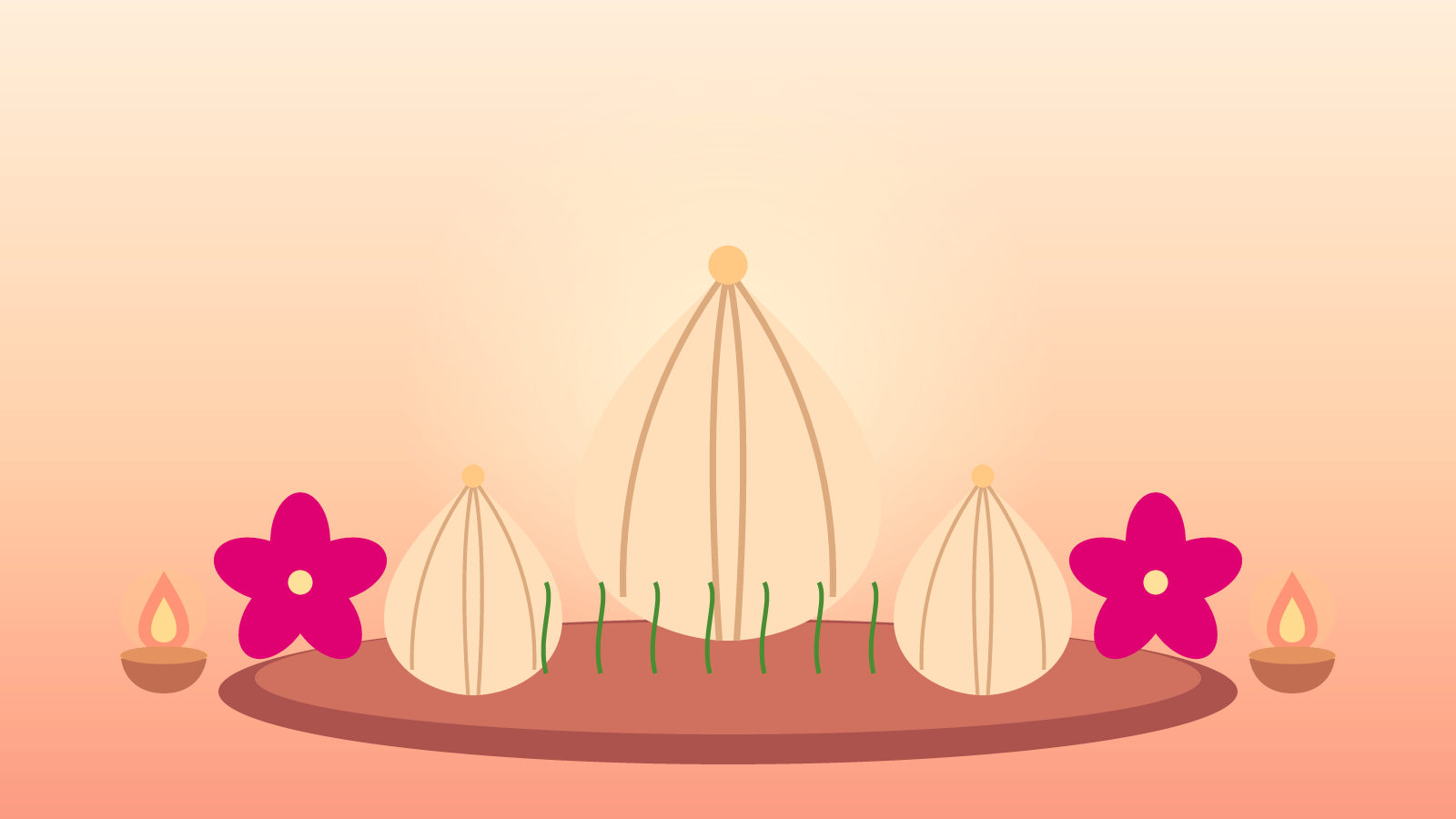
His favourite sweet is the modak, a sweet dumpling. His favourite offerings are durva grass, in bunches of twenty-one, and red hibiscus. If you are doing a short puja, a lamp, some durva and the mantra Om Gam Ganapataye Namah is enough.
The days to remember
- Chaturthi, the fourth tithi, every fortnight.
- Sankashti Chaturthi, in the dark fortnight, with a fast broken after moonrise. See this month’s date and moonrise time.
- Vinayaka Chavithi, the big festival, in the month of Bhadrapada.
For mantras and meanings see our Ganesha page.
Ganesha puja on Wednesday: a simple routine
Wednesday, Budhavaram, is a day many families keep for Ganesha, along with Vishnu. A short puja:
- Bathe, wear clean clothes, and light a lamp at the shrine.
- Offer durva grass (21 blades is traditional), a red flower and, if you can, a modak or any sweet.
- Say the mantra Vakratunda Mahakaya, Suryakoti Samaprabha, Nirvighnam Kuru Me Deva, Sarva-Karyeshu Sarvada, which means O Lord with the curved trunk and great form, bright as a million suns, remove obstacles from all that I do, always.
- Or the short one: Om Gam Ganapataye Namah, 21 or 108 times.
- Begin something small. Wednesday is a good day to start a task you have been putting off, for Ganesha is the one who opens the way.
Why he comes first
In every puja, whether for Lakshmi, Shiva or a house-warming, the first prayer goes to Ganesha. The stories give several reasons, and they are all in this article. The simplest is the one the tradition prefers: a beginning is always uncertain, and Ganesha is the god of uncertain beginnings.
Ganesha and the Mahabharata
One of the loveliest stories about Ganesha is that he was the scribe of the Mahabharata. Vyasa, the story says, wanted someone to write down the epic as he dictated it. Ganesha agreed on one condition: Vyasa must not stop. Vyasa replied that Ganesha must understand each verse before writing it. So whenever Vyasa needed a rest, he would pose a hard verse, and Ganesha would stop to think. The tale is not in the oldest manuscripts, but it shows what the tradition values in him: a mind that listens before it writes.
A few of his names
Ganesha has many names, and each is a small lesson. Vighneshwara, lord of obstacles. Ekadanta, the one-tusked, who broke his own tusk to write. Lambodara, the big-bellied, who holds the world’s troubles without complaint. Vinayaka, the leader who has no one above him. Saying the names is a short practice in itself.
Temples to know
Kanipakam in Andhra Pradesh, where people take oaths before the self-formed Vinayaka (see Kanipakam Vinayaka), the Pillayarpatti temple near Karaikudi in Tamil Nadu, and the Siddhivinayak in Mumbai are among the best known. On the monthly Chaturthi days, see our Sankashti Chaturthi dates for the moonrise times.
Which Ganesha story did you grow up with? Write and tell us. hello@southwala.com
Quick answers
Why is Ganesha worshipped first?
Because he removes obstacles. Starting any work with his name is believed to clear the way.
Why does Ganesha have an elephant head?
In the most common story Shiva, not knowing the boy was Parvati’s son, cut off his head, and then replaced it with the head of an elephant to console her.
What is Sankashti Chaturthi?
It is the Chaturthi of the dark fortnight, observed every month for Ganesha, with a fast broken after moonrise.