Kanaka Durga of Vijayawada: the goddess on Indrakeeladri hill
Arjuna prayed here, Mahishasura was slain here, and every Dasara the Krishna river reflects a hill of lamps. The story of Kanaka Durga on Indrakeeladri.

Source: Temple tradition of Kanaka Durga, Vijayawada, and the Mahabharata (Vana Parva) for Arjuna’s penance. These are traditions as given by the temple.
Vijayawada is known today for its barrage, its food and its traffic. But for the people of coastal Andhra, it is the city of the goddess on the hill.
The hill of Indra
The temple of Kanaka Durga stands on Indrakeeladri, a rocky hill on the north bank of the Krishna river. The name, Indrakila, points to a tradition. The sage Indrakila, said to be a devotee of the goddess, did penance and asked her to settle on his hill. She agreed, and the hill took his name.
The Mahabharata (Vana Parva) tells us that Arjuna came to the Indrakila mountain to do penance to Shiva and obtained the Pashupata weapon, after a contest with a hunter, Kirata, who turned out to be Shiva. The temple tradition identifies the hill with that mountain.
Durga and Mahishasura
The temple tradition says that on this hill Durga, with the powers of all the gods, killed the demon Mahishasura. The icon of the goddess in the sanctum shows her as Mahishasura Mardini, with many arms, slaying the buffalo demon with her trident. Her name, Kanaka, golden, speaks of her radiance. The sanctum image is said to be self-manifested.
There is also a tradition that Adi Shankaracharya visited Indrakeeladri and installed a Sri Chakra here. It is among the claims linking Shankara to temples across the South, and is held by tradition.
Dasara in Vijayawada
The temple is at its busiest during Dasara, the nine nights of Navaratri. Each day the goddess is decorated as a different form: Bala Tripurasundari, Gayatri, Annapurna, Lalita Tripurasundari, Mahalakshmi, Saraswati, Durga, Mahishasura Mardini and Rajarajeshwari, among others. On the last day, the teppotsavam, the goddess is taken in a decorated boat on the Krishna river, as the hill is lit with lamps.
The red devotees
In Karthika and Margashira, thousands of men, women and children wear red clothes and a garland, and take the Bhavani Deeksha, a period of discipline lasting up to 41 days. At the end they climb the hill with a bundle of offerings on their heads, in a procession that fills the streets. The sea of red is one of the sights of Vijayawada.
What it teaches
- Strength and radiance go together. Her name, Kanaka, is gold.
- A place can hold two stories. Arjuna’s penance and the goddess’s victory share one hill.
- Discipline is a form of devotion. The Bhavani devotees give up comforts for weeks.
- A river city has a goddess. The temple, the river and the hill are one landscape.
Visiting
The temple is easily reached from Vijayawada’s railway station. Expect long queues during Dasara and Bhavani Deeksha periods. The climb can be done on foot, by car, or on the ghat road. Visit early. Footwear is not allowed in the temple.
Questions people ask
Is this one of the old Shakti peethas? The temple is among the best known goddess shrines of Andhra Pradesh, and devotees treat it as a great seat of the Mother. The temple tradition is what we have given here, and it is best to ask the temple office if you want an official account.
What is the Bhavani Deeksha? It is a vow of discipline taken by devotees of the goddess, usually in the months we mentioned, and ended with a pilgrimage to the hill. If you know the Ayyappa vratam, the idea is similar. You can compare with Ayyappa and Sabarimala: the 41-day vratam. People take such a vow only after thinking carefully, and many consult elders in the family first.
Why red? Red is the colour of the goddess in many parts of India. It marks Shakti, energy and auspiciousness. It also makes a sea of devotees easy to recognise.
The hill and the river
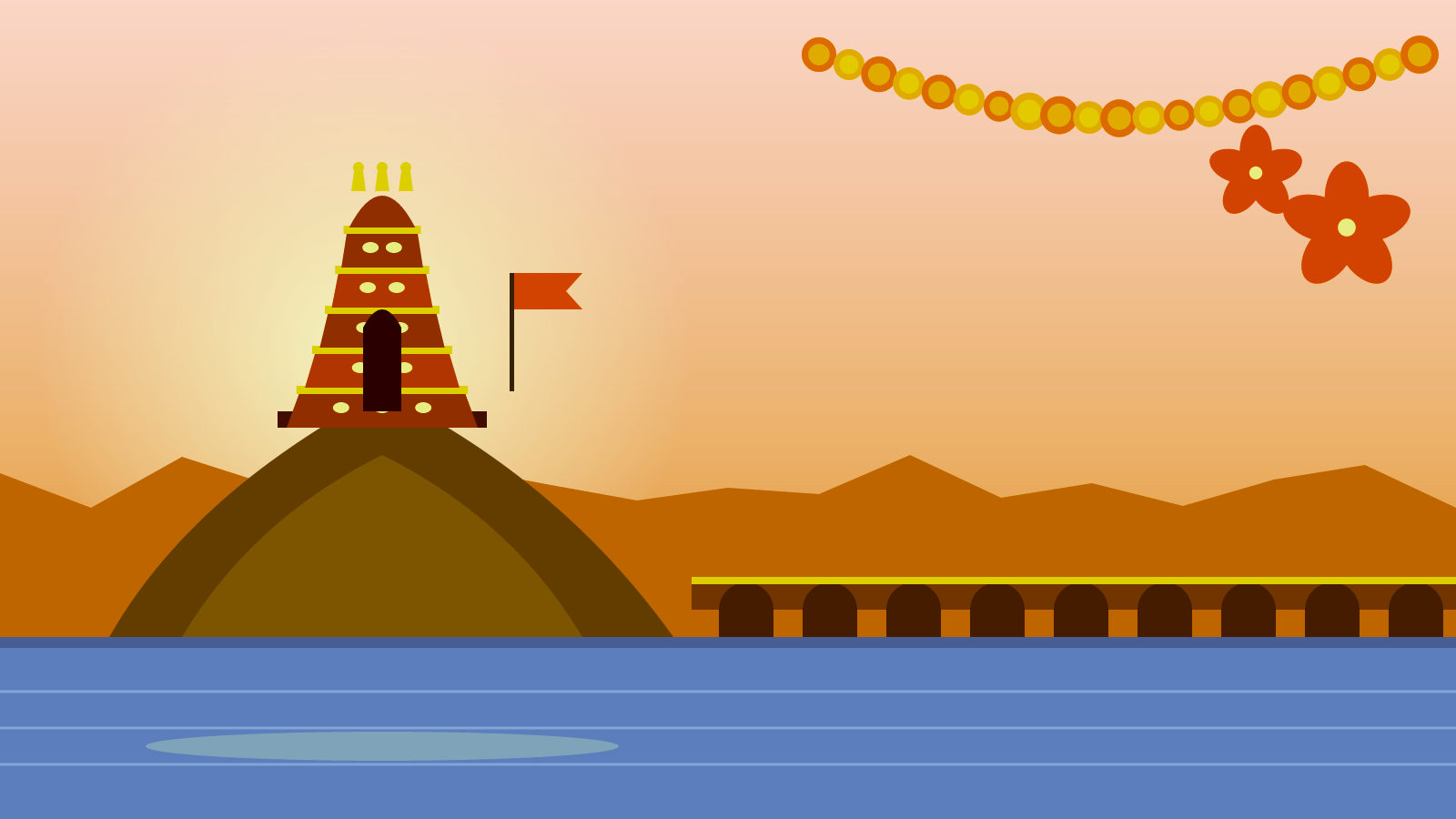
It helps to picture the setting. The Krishna river is wide at Vijayawada and flows past the base of the hill.
A hill beside a river, with a goddess at the top, is a pattern found across India. You climb, you pause, you look back at the city, and you feel the prayer become part of the view. The climb is part of the worship.
A quiet way to take part from home
If you cannot travel, there is something simple you can do on a Friday or during Navaratri:
- Light a lamp in front of a picture or image of the Mother.
- Offer a flower and say her name three times, Kanaka Durga.
- Sit for five minutes with your eyes closed, thinking of someone who needs strength.
- Share a little prasad with a neighbour.
That is enough. The goddess of the hill is also the goddess of the home.
Another goddess hill temple you might like is Chamundeshwari of Mysuru.
If you have climbed Indrakeeladri, or taken the deeksha, tell us about it at hello@southwala.com.
See also Krishna river: Krishnaveni, Srisailam, Vijayawada and the Pushkaralu and Kamakhya Devi.
Quick answers
Where is the Kanaka Durga temple?
On Indrakeeladri hill, on the bank of the Krishna river in Vijayawada, Andhra Pradesh.
Who was Indrakila?
A sage or yaksha who, in the tradition, prayed to Durga and asked her to remain on his hill, which was then named after him.
What is Bhavani Deeksha?
A vow of about 41 days taken in Karthika or Margashira in which devotees wear red and abstain from certain things, ending with a pilgrimage to the temple.