The ten avatars of Vishnu: what each one came to fix
A plain guide to the ten avatars of Vishnu, from Matsya to Kalki: each story in a few lines, what it teaches, and why different lists name different avatars.

Maybe you have seen the ten figures painted on a wooden Dashavatara set, or carved around a temple doorway, or acted out in a Yakshagana or Kuchipudi evening. A child points and asks, “Why is He a fish here and a man there?” It is a fair question, and the answer is the whole point of the idea.
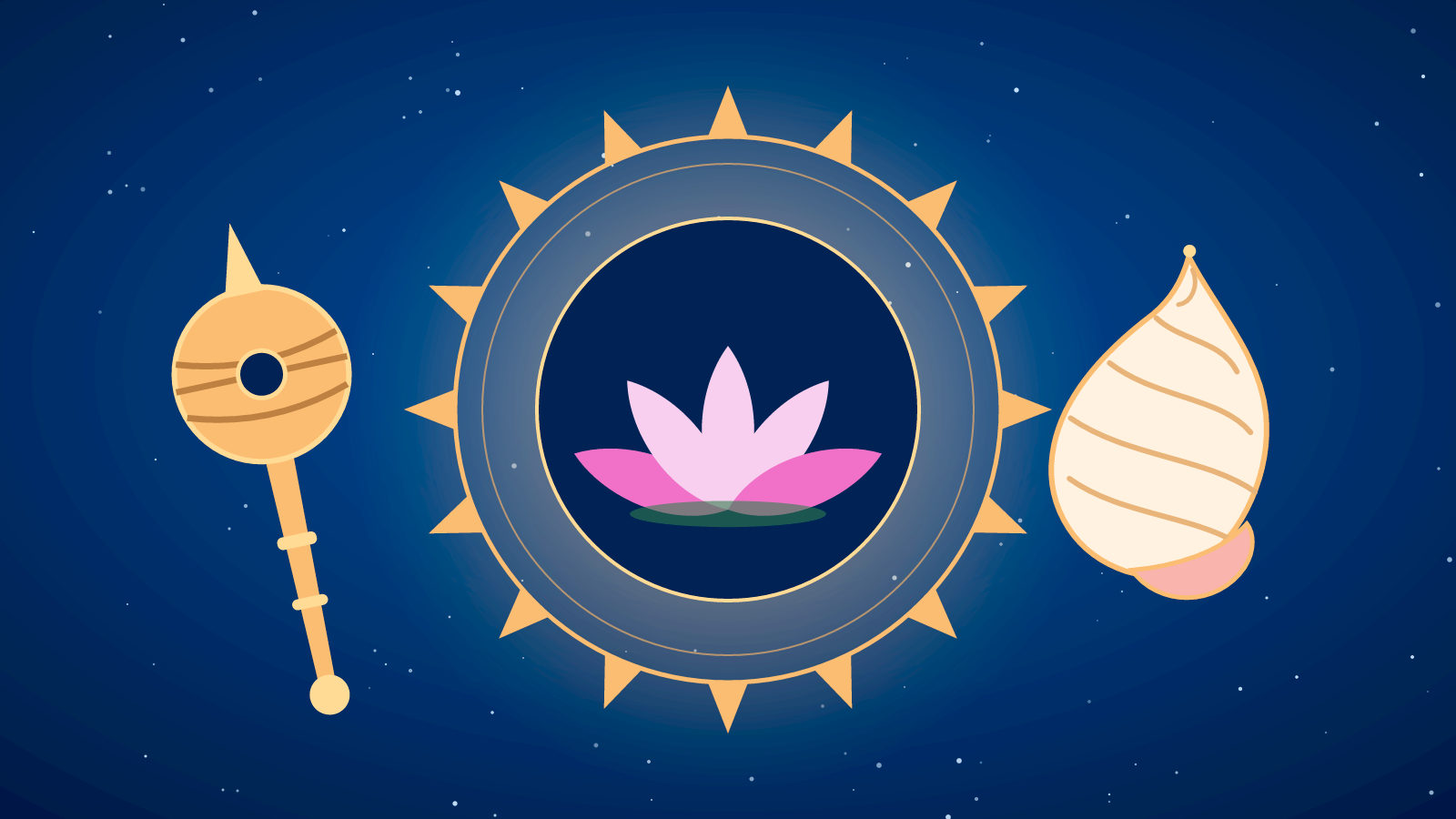
Vishnu is the preserver. Tradition holds that whenever the balance of the world tilts too far, He takes a form suited to the need and sets things right. The Bhagavad Gita says as much in its famous verse on dharma declining. The word avatara means a descent. The ten best known are called the Dashavatara, from “dasha”, ten.
The ten, one by one
Matsya, the fish. A great flood is coming. Vishnu appears as a fish, guides Manu’s boat, and saves the Vedas and the seeds of life. Teaching: the divine protects what is worth keeping when everything else is washed away.
Kurma, the tortoise. The gods and asuras churn the ocean for amrita, but the mountain used as the churning rod begins to sink. Vishnu becomes a tortoise and holds it on His back. Teaching: the great work of the world needs a steady base, and the quiet one underneath often carries it all.
Varaha, the boar. The earth, Bhudevi, is dragged to the bottom of the cosmic waters by the demon Hiranyaksha. Varaha lifts her out on His tusks. Teaching: the earth is held up by grace, and we are her guests.
Narasimha, the man-lion. Hiranyakashipu, Hiranyaksha’s brother, had a boon that he could be killed by neither man nor beast, neither indoors nor out, neither day nor night. His little son Prahlada kept faith in Vishnu. At dusk, on a threshold, Vishnu came out of a pillar as half man, half lion. Teaching: a child’s trust is stronger than a tyrant’s boon. Our temples section is a good place to look for shrines.
Vamana, the dwarf. The generous king Bali had grown so powerful that the gods trembled. Vishnu came as a small Brahmin boy and asked for three paces of land. Two steps covered heaven and earth; for the third, Bali offered his own head. Teaching: pride grows, but humility asks for little and receives everything. Kerala keeps this story close at Onam.
Parashurama, Rama with the axe. A sage’s son who took up the axe when rulers abused power. Tradition holds he is among the chiranjivis, the long-lived ones, and that he threw his axe into the sea to make the Konkan and Kerala coast. Teaching: power without restraint invites its own correction, and even the corrector must learn to put the weapon down.
Rama. The king who kept his word, even at the cost of his own throne. His story is the Ramayana, told in every South Indian language. Teaching: dharma is lived in small promises, between father and son, husband and wife, friend and friend.
Krishna. The cowherd, the charioteer, the teacher of the Gita. Born in prison, raised among cows, he guides Arjuna on the field of Kurukshetra. Teaching: be fully in the world and still be free of it. See Krishna, the cowherd, the king and the teacher.
Buddha. In many lists, the ninth is Buddha. In others, particularly some regional ones, it is Balarama, Krishna’s elder brother, the ploughman with the plough on his shoulder. The Buddha entry is read in different ways by different teachers, and you will hear more than one explanation in different households. Teaching: compassion, and a reminder that traditions can hold space for each other.
Kalki. Not yet come. Tradition holds that at the end of the Kali Yuga, Vishnu will appear on a white horse with a blazing sword to end injustice and begin a fresh age. Teaching: the story is not left unfinished; hope is built into the design.
Do all lists agree?
No, and that is fine. The Puranas name different numbers in different places, and some speak of twenty-two or even more descents. Dashavatara is the popular ten, the set you meet in temple carvings and bhajans. If your family counts Balarama, or names Hamsa or Mohini elsewhere, you are not wrong. Ask your elders, and write down what they say.
A traditional way of reading the order
Many teachers point to a pattern. The first forms live in water (Matsya, Kurma), then the land animal (Varaha), then the half-human (Narasimha), then the small human (Vamana), then full humans who grow in wisdom (Parashurama, Rama, Krishna). It looks a little like life itself climbing out of the sea and coming to a mind that can ask questions.
Take it as one traditional reading, a way to hold the ten together in memory. It is not a claim made by every text, and the devotee’s love for each form does not depend on it.
How to use this at home
A simple practice: on a quiet evening, tell one avatar story to a child, and ask what the child thinks it teaches. Don’t rush to supply the answer. Many families do this with Narasimha on Swati nakshatra days, or with Rama on Navami, and you can find upcoming days on our festival page.
Which avatar did your grandmother love most? Which one frightened you as a child, and which one do you quietly go back to now? Write to us at hello@southwala.com and tell us how the ten are remembered in your family, in your language, in your village.
Quick answers
What are the ten avatars of Vishnu in order?
The usual list is Matsya, Kurma, Varaha, Narasimha, Vamana, Parashurama, Rama, Krishna, Buddha and Kalki. Some lists place Balarama in the ninth position instead of Buddha.
Why do some lists have Balarama instead of Buddha?
Different Vaishnava traditions and regions compiled the list differently. Many families in the South know the Buddha version, while others count Balarama, Krishna's elder brother.
Which avatar is yet to come?
Kalki, who tradition holds will appear at the end of the Kali Yuga, riding a white horse and setting right a world that has lost its way.
Is the order of avatars a story of evolution?
Some teachers read it that way, moving from water to land to a half-human form to full humans. It is one traditional reading, not the only one.