Dhritarashtra: the blind king who chose not to see
Dhritarashtra's blindness, his love for Duryodhana, his questions to Sanjaya, Vidura's warnings and the iron Bhima: what the Mahabharata asks of a parent who will not look.

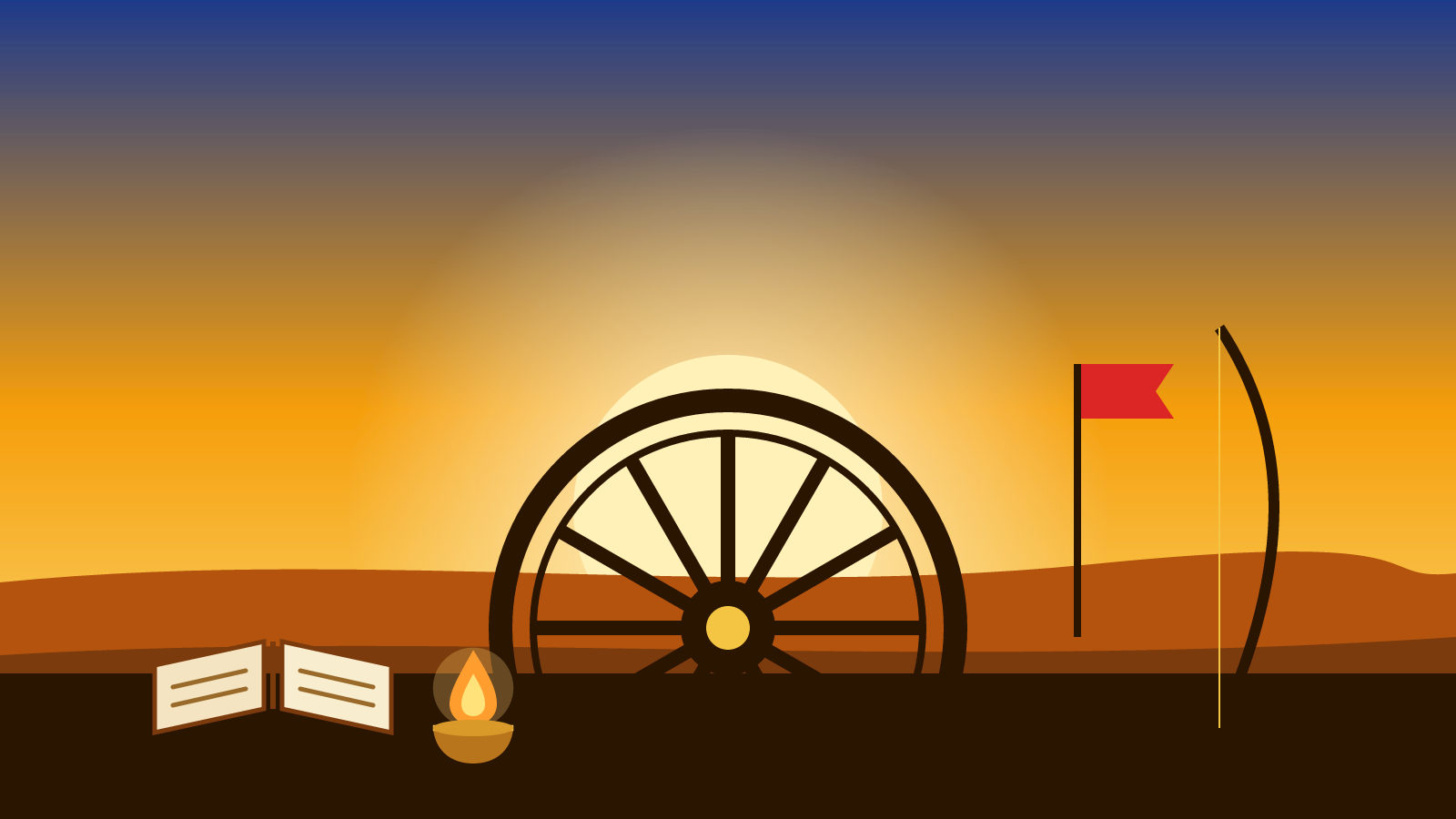
ధృతరాష్ట్రుడు పుట్టుగుడ్డివాడు, కానీ అతని అసలు అంధత్వం కొడుకు మీది మమకారం. విదురుడు, సంజయుడు చెప్పిన సత్యాన్ని విన్నా, అతడు దాన్ని పాటించలేదు.
Have you ever known a parent who simply refuses to hear one particular thing about their child? Everyone else in the room can see it. The parent changes the subject. Dhritarashtra (ధృతరాష్ట్రుడు) is the oldest example we have of that, and the epic does not treat him as a monster. It treats him as someone who could hear perfectly well.
Blind, and passed over
Tradition holds that Dhritarashtra was born blind because his mother Ambika shut her eyes in fear at the sage Vyasa. Because of this he was passed over for the throne, and his younger brother Pandu became king. Think about what that does to a person: a lifetime of being told, politely, that the crown is not for you.
Many readers feel this is the root of everything. The crown he was denied, he later wanted for his son. It is a human reading, and the epic seems to invite it, though the text itself does not state it as his motive.
Asking and asking
The most striking thing about him is how often he asks. When the war begins, he asks Sanjaya (సంజయుడు) what has happened, and the Gita itself starts with that question. Through the Bhishma Parva and after, he asks again and again: who struck whom, who fell, how did this happen? You can read the war as one long question put by a man who already half knew the answer.
I find one thing here worth noticing. Sanjaya answers honestly, sometimes at the risk of the king’s anger. Dhritarashtra listens, grieves, and still does not call his son back. The man who sits beside a river of bad news and does not step into it. For more on the narrator, see Sanjaya, the man who saw the war from a distance.
Vidura’s counsel
Vidura (విదురుడు), the king’s half-brother, is the one who says the hard thing plainly. Before the dice game and during the build-up to war, Vidura tells him that Duryodhana is leading the house to ruin, and that peace with the Pandavas is the only wise course. The famous Vidura Niti, in the Udyoga Parva, is a long night-time conversation of this kind: a king who cannot sleep and a counsellor who will not flatter.
The king says, in effect, you are right. He then does what his son wants. This is the pattern. Not a lack of knowing, but a lack of acting.
The embrace of iron
After the war, in the Stri Parva, the Pandavas come to meet the old king. He is to embrace them. Krishna, who knows his anger, moves the real Bhima aside and puts forward an iron figure. Dhritarashtra seizes it and crushes it to pieces. Then, the epic says, his rage drains away and he weeps, and is told what has happened. He then embraces the real Pandavas.
What does this scene say? That grief which has not looked at itself turns to violence, and that someone sometimes has to stand between that grief and the people it would hurt. It also says that Krishna did not abandon the old man; he managed him with care.
What the epic asks of a parent
Love of a child is not wrong. Dhritarashtra’s fault is that love became the only thing he allowed himself to hear. The epic’s question for parents, and for anyone who has influence over someone they love, is simple and difficult: do you help your child become good, or only comfortable and powerful?
His end is quiet. He goes to the forest with Gandhari and Kunti and dies there. The queen who chose a different kind of darkness is in Gandhari’s blindfold: why she chose the dark.
Why we judge him gently and sternly at once
Most readers feel pity for Dhritarashtra and anger at him in the same breath. Both feelings are right. He lost a throne, he lost a hundred sons, and he lived on to hear every name. The epic does not spare him that. In the Stri Parva he sits among the dead with the women of his house and has nothing left to command.
Yet he was a king, and a king is not only someone who feels; he is someone who decides. When Vidura said the house was going to be burned, Dhritarashtra was the only person in the palace who could have said stop. Blindness of the eyes did not stop him from ordering that the dice game be held, or from calling the Pandavas back to play again. The epic is not harsh on his disability. It is harsh on his choices.
A small test at home
You can try a quiet exercise. Think of a decision in your family where you hold some authority, however small. Now ask: who told me the truth about this, and what did I do with it? If the answer is that someone told you and you did nothing, you have understood Dhritarashtra better than many commentaries.
There is also comfort in the other side of the story. The old king was eventually led to let go of his pride. He went to the forest, he lived simply, and he was cared for by Gandhari, Kunti and Vidura’s memory. It is never claimed that a late turn erases the cost, but it is allowed to count.
Where this comes from
His birth is in the Adi Parva; his questions to Sanjaya begin the Bhishma Parva; the Vidura exchange is in the Udyoga Parva; the iron statue is in the Stri Parva; his departure to the forest is in the Ashramavasika Parva of Vyasa’s Mahabharata. Telugu Andhra Mahabharatam of Nannaya, Tikkana and Yerrapragada follows the same story, with its own poetry. The reading that his blindness explains his attachment is an interpretation, not a statement in the text.
A question to carry
What is the one truth about someone you love that you have heard more than once and still have not acted on?
If your family has a saying about Dhritarashtra, or a way of telling this story to children, write to us at hello@southwala.com.
Quick answers
Why was Dhritarashtra blind?
In the epic, tradition holds that his mother Ambika closed her eyes in fear when the sage Vyasa came to her, and the child was born blind. This is how the story is told in the Adi Parva.
Who told Dhritarashtra about the war?
Sanjaya, his charioteer and minister, was given the gift of seeing the battle from afar and reported it to the king. The Bhagavad Gita opens with the king's question to him.
What happened with the iron Bhima?
After the war, in the Stri Parva, Dhritarashtra was to embrace the Pandavas. Krishna put forward an iron statue of Bhima, and the king crushed it in his grief and anger.