Barbarika: the boy who could have ended the war in a minute
Barbarika, Ghatotkacha's son in folk and Skanda Purana tradition, his three arrows, Krishna's request for his head, and the Khatu Shyam temple in Rajasthan.

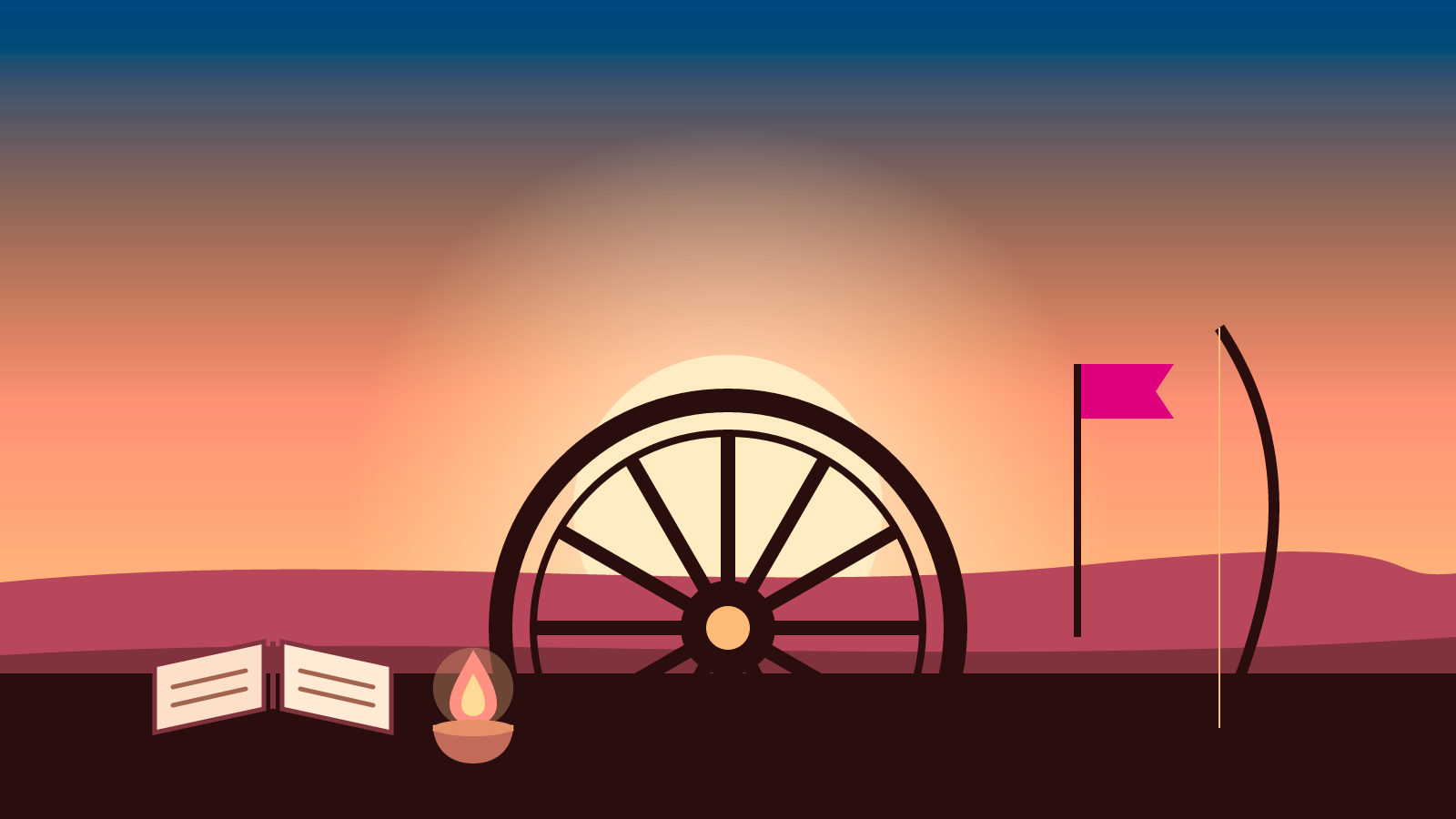
బర్బరీకుడు ఘటోత్కచుని కుమారుడని జానపద, స్కాంద పురాణ సంప్రదాయం చెబుతుంది. అతని కథ వ్యాసుని మూలపాఠంలో లేదు; రాజస్థాన్ లోని ఖాటు శ్యామ్ ఆలయంలో అతనిని ఆరాధిస్తారు.
If someone told you there was a single warrior who could finish the Mahabharata war in a minute, what would you ask him? Most of us would ask why he did not. The story of Barbarika is built around that question.
First, where he stands
Barbarika (బర్బరీకుడు) is not in Vyasa’s critical text of the Mahabharata. He belongs to folk tradition and to a later Purana, which tradition holds to be the Skanda Purana. Tellings differ in names and details, so let me give you the common outline and tell you plainly where it is tradition.
The boy and the arrows
In the story he is the son of Ghatotkacha, and so a grandson of Bhima. His mother’s name varies by telling. He is a devotee of the Mother, from whom he received three arrows and a bow.
The arrows work this way, as people usually tell it. The first marks everything he wishes to destroy. The second marks what he wishes to keep. The third strikes the marked things and returns. A man with such arrows could, by himself, finish an army.
Before the war, he promised his mother that he would fight for whichever side was weaker. Think about that promise. It sounds noble. It also means that if his side wins, it becomes the weaker side, and he must change over, again and again, so that no war can ever end.
Krishna’s test
Krishna, the story goes, met him on the way and asked what he could do. The boy said he could end the war in a minute. Krishna asked him to mark all the leaves of a peepal tree. The boy did. Krishna had hidden one leaf under his foot, and the arrow went to the foot as well.
Seeing that no side could survive the boy, Krishna asked him for a gift, and it was the boy’s head. The tellings say Barbarika agreed at once, asking only that he be allowed to see the war. The head was placed on a hill to watch. When the war ended, the Pandavas argued about who had won the credit. The head, which had seen everything, said it was Krishna’s chakra that fought and Draupadi’s anger that fed it. Krishna blessed him with a name and a future worship.
For the father’s side of the family, see Ghatotkacha, the night Krishna smiled at a death.
Why Krishna asked
This is the hard part. Why would the Lord ask a young devotee for his head?
Tradition offers readings. One is that the war was a matter of dharma, not a contest of strength, and that a power which could end it without a single moral decision could not be allowed to decide. Another says that the gift of the head was itself his liberation. A third reading, more uneasy, is that Krishna was simply asking the cost of a war.
I do not think the story hides the unease. Many families who tell it do so quietly, because a boy gave his life.
Khatu Shyam and other places
In Rajasthan, he is worshipped as Khatu Shyam. Tradition holds that his head is at Khatu, in the Sikar district, and a large fair is held there each year around the Phalguna month. Many devotees come, often on foot.
In parts of Andhra and Telangana I have heard it said that folk tellings carry the same figure under a name something like Kharu, but I am not sure of the name or of the places, and I would not want to state it as fact. If you know such a tradition from your own village, I would like to hear it.
What it asks of us
The story is a lesson about power. A great ability is not the same as a right to use it. The boy’s promise to side with the weak was generous, but it had no way of ending anything. Dharma, in this telling, needs judgement and not only strength.
Three arrows and a lesson about power
Some tellers read the three arrows as an image of choosing: what to end, what to keep, and the act itself. What makes the story hard is that the boy has the power to do all three and no way of telling which is right. He relies on a promise made early, and a promise is a poor guide to a battlefield.
In that sense Barbarika is the opposite of Arjuna. Arjuna, at the start of the Gita, hesitates because he sees too much. Barbarika, in the story, does not hesitate at all. Krishna answers Arjuna with a long teaching. To Barbarika he answers with a request. You can read the pair together with the Bhagavad Gita, if you want to think about action and doubt.
At Khatu
Those who go to Khatu often say they go for the sense of surrender in the story: the idea of giving up what you are proudest of. Devotees there call him Shyam Baba and Hare ka Sahara, the support of the one who is losing. That title comes from his promise. I cannot speak for the temple’s rules or timings; if you plan to go, please check locally.
What I can say is that his memory is warm, not grim. People do not tell it as a tragedy only. They tell it as a boy who gave everything and was remembered for it.
Where this comes from
The story is told in folk tradition across north and western India and in a later Purana, usually said to be the Skanda Purana. It is not in the Vyasa Mahabharata’s critical text. Details such as the mother’s name, the leaf test and the head’s witness differ between tellings.
A question to carry
If you had a power that could settle an argument at once, in your family or at work, would you want to use it, and who would you ask first?
If your family keeps a Khatu Shyam or Barbarika tradition, please write to us at hello@southwala.com.
Quick answers
Is Barbarika in the Mahabharata?
He is not in Vyasa's critical text. His story belongs to folk tradition and is told in a later Purana, which tradition holds to be the Skanda Purana.
Who is Khatu Shyam?
In Rajasthan, devotees worship Barbarika as Khatu Shyam, and the head is said to have been found at Khatu in the Sikar district. A large fair is held there each year.
What were Barbarika's three arrows?
In the story, the first marks what he wants to destroy, the second marks what to protect, and the third strikes the marked things. Tellings differ on the details.


